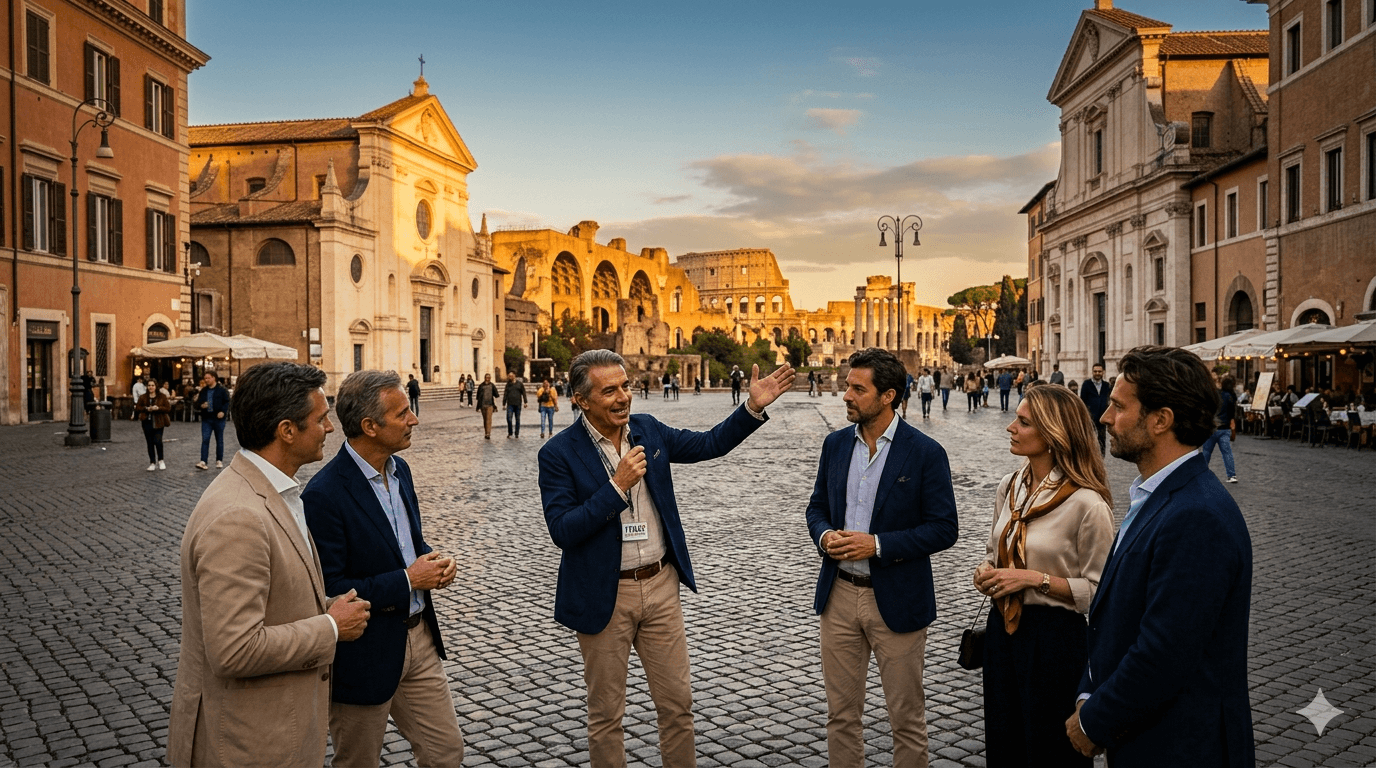
2026 guide · Updated March 2026
To open a tour operator in Italy in 2026 you follow a precise process: the tourism SCIA, a technical director, a guarantee fund, liability insurance and an initial investment of €15,000 to €60,000. This guide by the TourLeaderPro editorial team, the network of Daniele Dezi, a licensed tour escort based in Rome, sets out permits, costs and promotion strategies, from Rome to Venice.
- €15,000–60,000Initial investment
- 6–10 wksFrom idea to operating
- 4Cities compared
The industry in 2026
A growing market
2025 set a historic record with over 450 million nights from international tourists, and 2026 confirms growth of 6–8%. Specialised, niche and experiential tour operators are growing fastest: travellers want authenticity and personalisation, not what they can find on Google Maps.
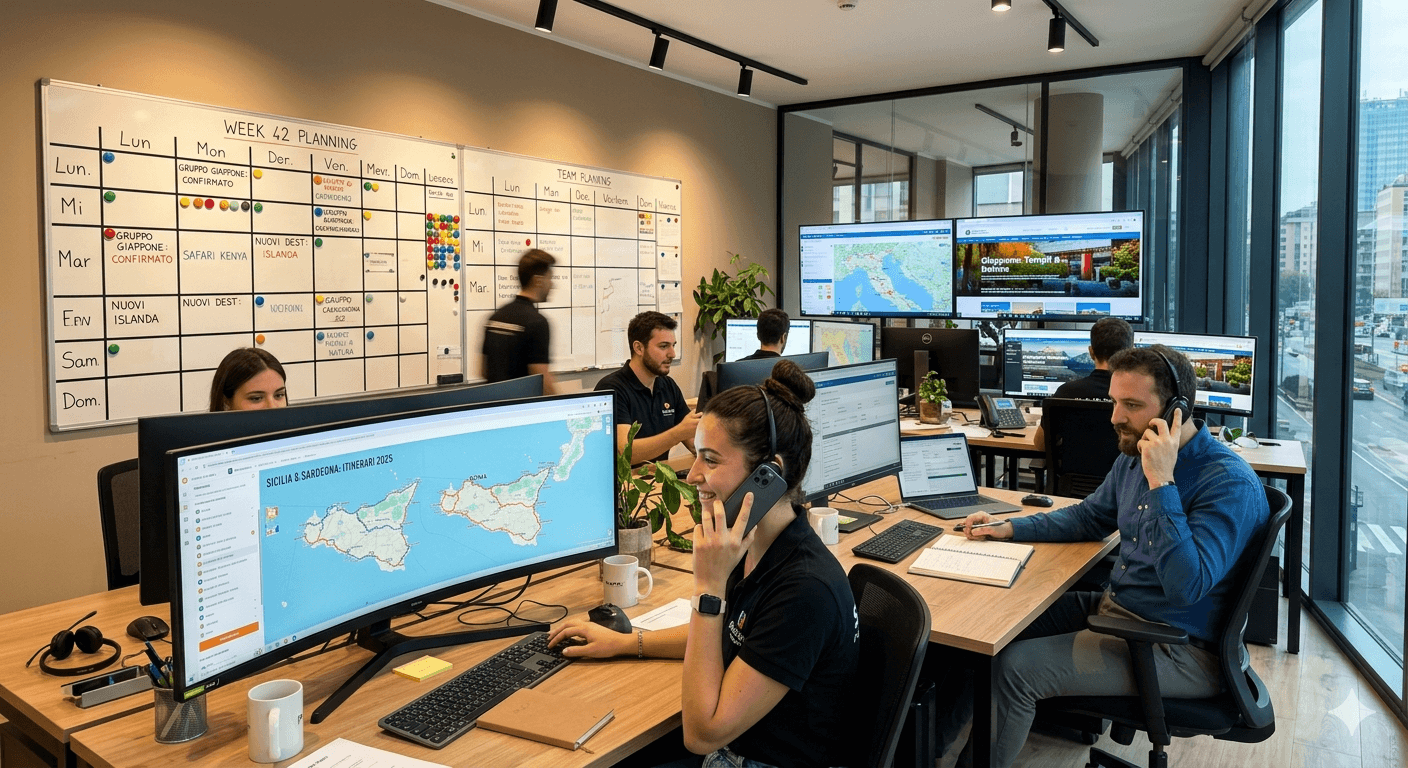
- Experiential tourism: food tours, night tours and themed tours growing on Viator and GetYourGuide
- Luxury and VIP: golf cart tours, exclusive tastings, privileged access
- School and conference travel: stable, less seasonal
- Bleisure: work and leisure combined, longer stays
- Sustainability: Anglo-Saxon and Northern European clients choose certified operators
Reference regulations
Tour operator or travel agency
The line has blurred since EU Directive 2015/2302: if you produce experiences and tours, you are a tour operator in every respect.
Produces packages
Buys services wholesale, assembles and sells them, with full contractual liability to the end client. Examples: a 5-day tour of Sicily, a Rome food tour, a Tuscany itinerary with private driver.
Distributes others’ products
Sells products made by others, mainly by tour operators, acting as intermediary between client and suppliers.
Tourism Code
Covers the package, disclosure duties, operator liability, withdrawal and insolvency protection. Full text on Normattiva.it.
Transposed by Decree 62/2018
Extended package definition (linked travel arrangements), mandatory insolvency protection, standard pre-contract information. The revision voted on 12 March 2026 widens liability for packages sold on digital platforms, linked services and information duties.
Regional laws
Tourism is a regional matter (art. 117 of the Constitution). Lazio R.L. 13/2007, Lombardy R.L. 27/2015, Tuscany R.L. 61/2024, Veneto R.L. 11/2013.
Legal structures
Setting up the company
If you are starting from scratch, an SRL is the best choice: many new operators begin with an SRLS and convert to an SRL later.
Sole proprietorship
Very low costs, unlimited liability. ATECO 79.12.00 or 79.90.04.
SRL or SRLS
Limited liability and professional credibility. Capital from €1 (SRLS) or €10,000 (SRL).
SNC, SAS, SPA
SNC and SAS for light partnerships; SPA for large operators, with minimum capital of €50,000.
The tourism SCIA
The process in four steps
VAT number, CCIAA, ATECO
Open your VAT number and register with the Chamber of Commerce under ATECO 79.12.00.
Technical Director
A mandatory role: without a DT you cannot file the SCIA. The DT oversees packages, ensures compliance, is the contact for the authorities and signs contracts.
Insurance and guarantee fund
The policy is a pre-SCIA requirement: without a valid policy you risk penalties.
SCIA to the SUAP and register
File the SCIA with the municipal SUAP with all documents and register in the Regional Register of Tourism Businesses. You may operate from filing.
Guarantees and insurance
Guarantee fund and policies
The fund protects the client in case of insolvency or bankruptcy: repatriation, refund of sums paid, itinerary adaptation.
Guarantee fund
Minimum cover by expected turnover: up to €500,000 needs €50,000; up to €1,500,000 needs €100,000; up to €5,000,000 needs €200,000; above €5,000,000 needs €400,000.
Professional liability
Covers damage to third parties. Minimum limit of €1,000,000 per claim.
Insolvency and bankruptcy
Feeds the guarantee fund. Insurers: Allianz, AXA, Generali, Zurich, Lloyd’s.
Medical and baggage
Recommended: operators that include it convert better.
Detailed budget
What it costs to open a tour operator in Italy
Three scenarios, from minimal startup to premium operator.
- VAT number and CCIAA: €200–300
- SRLS incorporation: €0–500
- Policies (liability and insolvency): €1,300–2,000
- SCIA: €100–300
- Software and website: €500–2,100
- Initial marketing: €1,000–3,000
- Accountant: €1,500–2,500
- Cash reserve: €3,000–5,000
- SRL incorporation and capital: €5,000–14,000
- Office and fit-out: €5,000–14,000
- Policies: €2,300–5,000
- Professional website and CRM: €4,000–11,000
- First-year marketing: €5,000–15,000
- Team and consultants: €11,000–25,000
+€20,000–60,000
Premium TO
Scenario C: VIP, golf cart, luxury, on top of the basic costs.
Request consulting- Golf cart: €12,000–40,000
- Type approval: €500–2,000
- Restaurant agreements: €2,000–8,000
- Specialist guides: €3,000–8,000 a month
Timing and people
From idea to opening
Realistic total time to open a tour operator in Italy: 8–16 weeks. Business plan, legal form and DT search: 1–2 weeks; notary deed, bank account and capital: 1–2 weeks; VAT number, CCIAA and ATECO: 3–7 days; policies and guarantee fund: 1–2 weeks; SCIA to the SUAP: 1–3 days; operating from week 8; regional register and checks by the authorities: 30–60 days.
You qualify as DT with the regional licensing exam, a tourism or economics degree plus 2 years of experience, or a recognised EU qualification. It costs €1,500–3,500 a month if employed, €500–1,500 if external. Where to look: Confturismo, ASTOI, FIAVET, LinkedIn and the TourLeaderPro directory.
Technology and marketing
Tools for finding clients
Getting authorised is the easy part. Finding clients is the real challenge.
Booking engine
Regiondo, FareHarbor, Peek Pro, Bókun.
CRM
HubSpot (free), Salesforce, Tourwriter, TravelJoy.
Tour operator software
Lemax, TourCMS, Tourwriter, Travelport.
SEO
A page for every tour (800+ words, FAQ, gallery, prices), 2 blog posts a month, an optimised Google Business Profile, link building from authoritative sites.
OTAs
Keyword-rich titles, 10–15 professional photos, quick replies to reviews, Instant Confirmation on.
Social, email, B2B
Reels 3–4 times a week, micro-influencers, content in English. Mailchimp or Brevo with post-tour sequences. Partnerships with hotels, concierges, incoming agencies, schools and companies.
Four cities compared
Rome, Milan, Florence, Venice
Products, regulations, timing and monthly searches for each city.
Rome
Over 35 million overnight stays: the most competitive and richest market. Top: Colosseum and Forum, Vatican, food tours, golf carts, underground, night tours. Niches: VIP golf cart, sunset (€80–150), Secret Rome, families, tours in Russian, Chinese and Portuguese. SCIA to the Roma Capitale SUAP. Searches: tour Colosseo 60,500, tour Roma 40,500, tour Vaticano 33,100, food tour Roma 8,100, golf cart Roma 2,400.
Milan
Tourism up 28% since 2022. Top: Duomo, food and wine, fashion and design, Last Supper, Lake Como and Franciacorta. Niches: showrooms, Navigli and Isola, City Life and Porta Nuova, MICE. Milan SUAP, virtual office accepted. Searches: tour Milano 22,200, Lake Como 18,100, Duomo 8,100, food tour 4,400.
Florence
350,000 residents and over 12 million tourists. Top: Uffizi, food tours, Chianti and Brunello, private art historian, cooking classes, David and Accademia. Niches: Uffizi at dawn (€150–300), artisan workshops, photo tour. SCIA plus mandatory RIPT registration. Searches: tour Uffizi 22,200, tour Firenze 14,800, Chianti 5,400.
Venice
€5 access fee since 2024: the most unique and regulated market. Top: gondola, authentic Venice on foot, lagoon, Murano, Carnival, Biennale, cicchetti. Niches: dawn photography, crafts (€80–200), Carnival (€300–1,000). SCIA, DT register, boating licence for vessels. Most searches are in English: an Italian-only site loses 80% of the market. Searches: gondola tour Venice 33,100, tour Venezia 27,100, Murano 8,100.
What to avoid
Six fatal mistakes
For each mistake, the fix.
Cheap policies
Use a broker that specialises in tourism.
Copying prices
Work out your breakeven and differentiate on value.
Neglecting reviews
Ask within 24 hours and reply to all of them.
Relying on one channel
Viator, GetYourGuide, your own site and B2B together.
No serious contract
A specialised lawyer costs €1,000–2,000.
Ignoring seasonality
Low-season products and a 3-month reserve.
Related resources
Frequently asked questions
Can I open a tour operator in Italy without experience?
Yes, but you need a qualified DT. Our advice is to work first as a tour leader.
Can I operate online only?
Yes, most Regions accept a virtual office.
Can I sell tours outside my Region?
Yes, with no geographical limits once you are authorised.
How does VAT work for packages?
Special VAT scheme for travel agents (art. 74-ter of Presidential Decree 633/72): VAT only on the margin. You need an experienced accountant.
Your next step
The market is expanding and the specialised operator segment is far from saturated. From training to consulting for starting a tourism business, we give you the resources and the network you need. Bureaucratic process: 8–16 weeks.
Tour operator consultingPhone and WhatsApp: +39 327 287 7812
Regulatory data updated to March 2026. By the TourLeaderPro editorial team.